Table of contents
A working definition#
Ask ten readers what tarot is and you will hear ten answers, but most of them circle the same idea: tarot is a symbolic vocabulary. The deck holds seventy-eight pictures of situations every person eventually meets — starting something with no guarantees, holding on too tightly, grieving, rebuilding, choosing. When you draw a card next to a real question, the image gives your question a shape to think with.
In TarotSelf the deck is shuffled randomly, and the value comes from the connections you make between the image and your situation — the same reason a poem or a photograph can stop you mid-thought. Readers who hold a more spiritual view of the cards are welcome here too; the practice below works either way.
What’s in the 78-card deck#
A standard tarot deck divides into two halves that do different work.
| Major Arcana | Minor Arcana | |
|---|---|---|
| Cards | 22 | 56 |
| Scope | Big themes and turning points | Everyday textures of a situation |
| Examples | The Fool, Death, The World | Three of Cups, Nine of Swords |
| Structure | A single sequence, 0–21 | Four suits of fourteen cards |
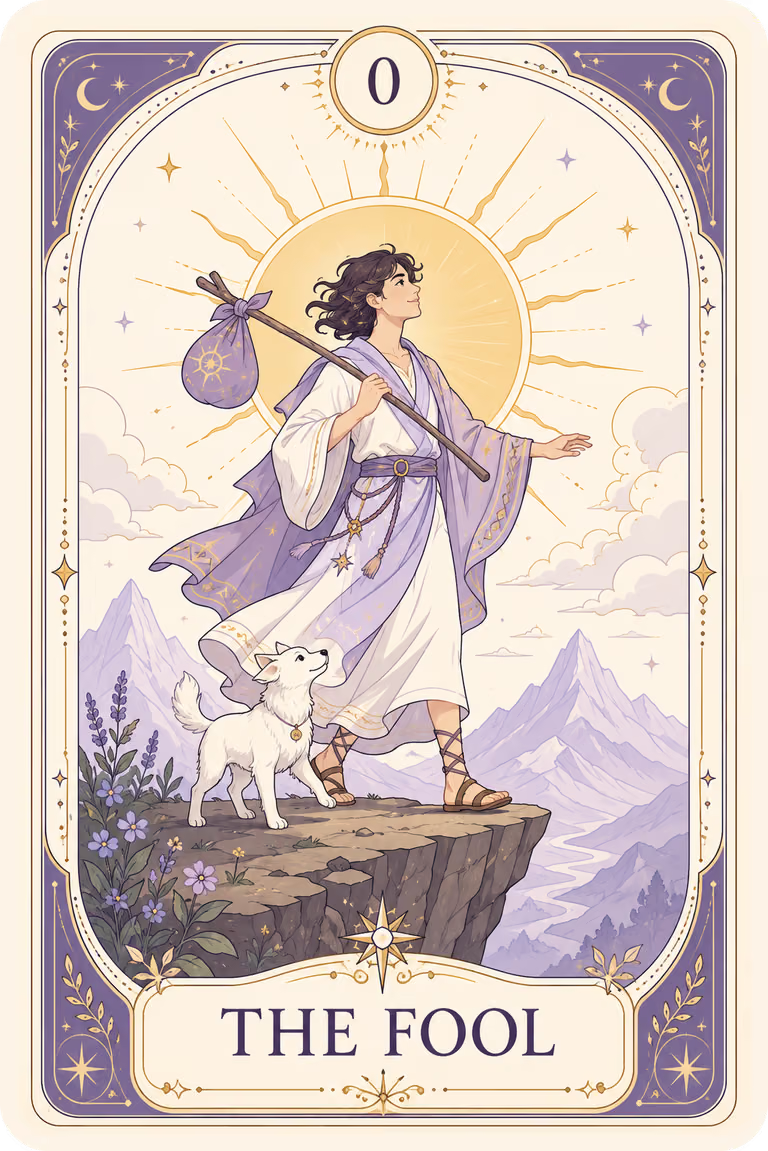
Modern readers often arrange the 22 Major Arcana into an interpretive sequence called the Fool’s Journey — a symbolic path from openness and inexperience toward integration and completion. That reading is a later tradition rather than the cards’ original design, but it is a useful one: the Majors deal in the large movements of a life — initiations, reckonings, releases, returns.
The 56 Minor Arcana split into four suits. In many modern traditions, Wands are associated with drive and action; Cups with emotion and relationships; Swords with thought and conflict; Pentacles with material and embodied life. Each suit runs Ace to Ten, then adds four court cards. Where the Majors name the theme, the Minors describe the scene.
A brief, honest history#
Tarot began as a card game. The earliest surviving decks come from northern Italy in the mid-fifteenth century, commissioned by noble families for a trick-taking game known as trionfi and later tarocchi. For roughly its first three centuries, tarot was entertainment — closer to bridge than to divination.
The divinatory tradition is real, but younger. It took shape in late-eighteenth-century France, where writers and professional card readers began publishing symbolic systems for the deck — including a popular but unfounded story that the cards preserved ancient Egyptian wisdom. That origin myth has been repeated ever since; historians find no evidence for it.
Many modern English-language decks draw heavily from the Rider–Waite–Smith deck, first published in 1909 and illustrated by Pamela Colman Smith. Its fully illustrated pip cards made the Minor Arcana easier to read through images as well as memorised meanings. Other living traditions — the Tarot de Marseille and the Thoth deck among them — follow different lines. Where a deck does illustrate every card, those scenes are a large part of why it suits reflection: each card hands you a small, legible story.
It is worth keeping the two threads distinct. That tarot began as a game and acquired its symbolic tradition later is documented history. What the symbols mean is interpretive tradition — a conversation that has stayed alive precisely because each generation of readers renews it.
How tarot can support reflection#
Strip away the theatre and a tarot reading is a short, structured pause: you name a question, you meet an image you did not choose, and you ask what it shows you. Three things make that simple ritual genuinely useful.
- It interrupts your usual angle. You have thought your question in circles; the card approaches it from the side, through a picture you would not have picked yourself.
- It gives feelings a vocabulary. “The Nine of Swords” is easier to look at — and talk about — than a 3am worry with no name.
- It creates a record. Write down what you noticed, and over weeks your readings become a journal of what kept asking for attention.
None of this requires believing anything about how the card arrived. The card is randomly drawn; the meaning is made by you, in the meeting between the image and your situation. That is not a weakness of tarot. It is the point.
What tarot cannot do#
Tarot does not know the future. It cannot tell you whether to take the job, whether someone will come back, or how a diagnosis will unfold. A card is not evidence about the world; it is a lens on your own thinking — which is why the question you bring matters more than the card you draw.
It follows that tarot is no substitute for a doctor, a lawyer, a financial adviser or a therapist. If a reading ever leaves you feeling frightened or dependent on the next one, that is a signal to put the deck down — reflection should widen your agency, not narrow it.
Why a reading can feel so personally relevant#
Draw a card with a real question in mind and the fit can be uncanny. The fit can feel personal because the cards portray broad human situations, while your question directs your attention toward particular details. Your mind connects the image with what you already know, fear, hope or suspect about the situation.
The card does not prove that interpretation to be true. It gives you something concrete to examine. Often the relevance comes from connections your mind makes between the image and what you already know about your situation — and those connections are worth examining, not automatically believing.
How to begin — without memorising 78 cards#
Start with one card a day
Draw a single card, look at the image before reading any meaning, and ask: what in my day does this touch? Five minutes is plenty.
Bring a real question
Open questions work best — “what am I not seeing about this?” rather than “will it work out?”. The first invites reflection; the second asks the card to be an oracle, which it is not.
Look meanings up as you meet them
Let the deck teach itself card by card. Meeting the Tower in a real reading will teach you more than memorising it from a list ever could.
Keep a few written lines
A sentence on what you drew and what it stirred. The habit of writing is where a reading turns into reflection.
Common misconceptions#
- “Tarot predicts the future.” It does not. It reflects the present — which is often what a question about the future is really about.
- “Death or the Tower are bad omens.” The cards name experiences — endings, sudden change — not verdicts. In practice they are among the most useful cards to sit with.
- “You need a gift to read.” Reading tarot is a literacy, not a talent. Anyone willing to look at an image honestly can do it.
- “Someone must gift you your first deck.” A folk custom, nothing more. Choosing your own deck is a perfectly good beginning.
A small exercise before you ever touch a deck#
Key takeaways
- Tarot is a 78-card symbolic vocabulary: 22 Major Arcana for life’s big themes, 56 Minor Arcana for its daily textures.
- It began as a fifteenth-century Italian card game; the divinatory tradition dates to eighteenth-century France.
- A reading reflects the present rather than predicting the future — its value is what you notice, not what it foretells.
- You can start today with one card and one open question. No memorisation, no special gift required.
Frequently asked questions
Do I have to believe in anything for tarot to work?
No. You can use tarot as a structured reflection practice without holding any spiritual belief about the cards: a randomly drawn image, a real question, and your own honest attention are the only required ingredients.
Is tarot connected to a religion?
No. Tarot emerged as a European card game and its symbolic tradition draws on many sources. People of many faiths — and none — use it, and nothing in the practice requires a religious commitment.
Can I read tarot for myself?
Yes. Many people begin by reading for themselves. The main risk is hearing only what you hoped to hear, which is why open questions and a few written lines after each reading matter more than experience.
Continue your practice
The fastest way to understand a reading is to sit with one.