Table of contents
What the Major Arcana are#
A tarot deck holds 78 cards in two groups. The 56 Minor Arcana divide into four suits and describe the everyday scene — a conversation, a worry, a piece of work. The 22 Major Arcana belong to no suit. They are numbered 0 to 21, each with a name and a distinct image, and they speak to the themes underneath the scene: what is beginning, what is ending, what you are being asked to face.
They are sometimes called trumps, a word left over from tarot’s first life as a card game in fifteenth-century Italy, where these cards outranked the suits in play. The symbolic reading came centuries later. The ranking is a game mechanic; the meaning is interpretation.
How they behave in a reading#
A common shorthand says a Major card is more important than a Minor one. Treat that as convention rather than rule. What is more useful — and more accurate to how readings actually go — is that Majors tend to describe the frame around a situation, while Minors describe what is happening inside it.
If you ask about a difficult week at work and draw the Five of Pentacles, you are looking at the week. If you draw the Tower, you are being invited to look at what the week belongs to — a structure that may already have been under strain. Neither card predicts anything. The Major simply widens the lens.
The Fool’s Journey — a modern interpretive frame#
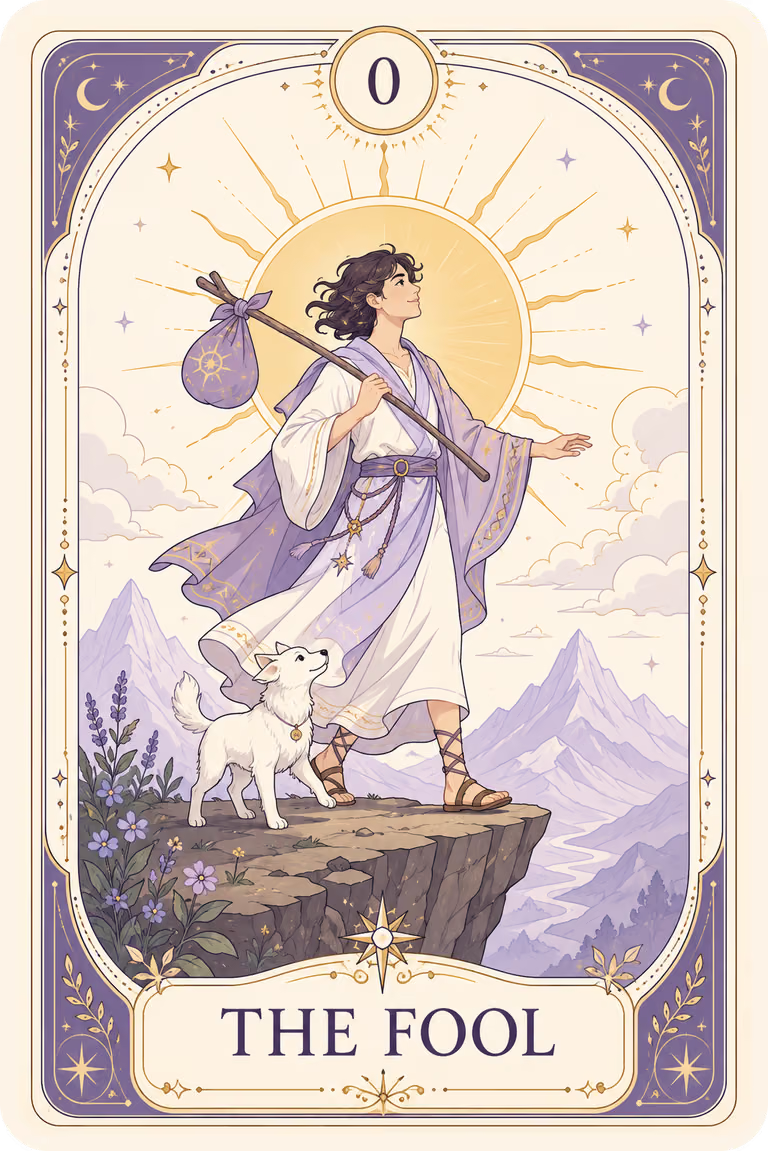
Modern readers often arrange the 22 Majors into a sequence called the Fool’s Journey: the Fool at 0 steps out with nothing, meets a series of figures and forces, and arrives at the World at 21 having integrated what the road taught. It is a genuinely useful way to learn the cards, because it gives each one a place in a shape you can remember.
It is worth being clear that this is a later reading rather than the cards’ original design — the sequence was a game order long before anyone described it as a spiritual arc. Hold it as a helpful frame, not as the meaning the cards were built to carry.
Read in that light, the twenty-two fall roughly into three movements: the first seven cards are about finding your footing in the world; the middle group is about being tested and turned by it; the final cards are about seeing clearly and coming back whole.
All 22 Major Arcana cards#
Each card below links to its full page, where you will find its imagery, upright and reversed meanings, keywords and correspondences. You do not need to memorise these — read the one in front of you when it appears.
The Fool
beginnings · innocence · leap of faith
The beginning of everything, before you know enough to be careful. The Fool is about stepping out without guarantees — which is either courage or recklessness, and often you only find out later.
Explore The Fool →The Magician
manifestation · willpower · skill
Having what you need and knowing it. The Magician is focused will: the moment when scattered ability becomes a single intention pointed at something real.
Explore The Magician →The High Priestess
intuition · mystery · subconscious
What you know but have not said out loud. She points to the quiet, unproven kind of knowing — and to the value of waiting before you act on it.
Explore The High Priestess →The Empress
fertility · abundance · sensuality
Growth, care, and letting something take its own time. The Empress is about tending — a relationship, a body, a piece of work — rather than forcing.
Explore The Empress →The Emperor
authority · structure · discipline
Structure, boundaries, and the discipline that makes freedom possible. At his best he is the order that protects; at his worst, the order that refuses to bend.
Explore The Emperor →The Hierophant
tradition · mentorship · belief
Tradition and the wisdom held by institutions — a teacher, a faith, a way things have always been done. The question he raises is which inherited rules still deserve your loyalty.
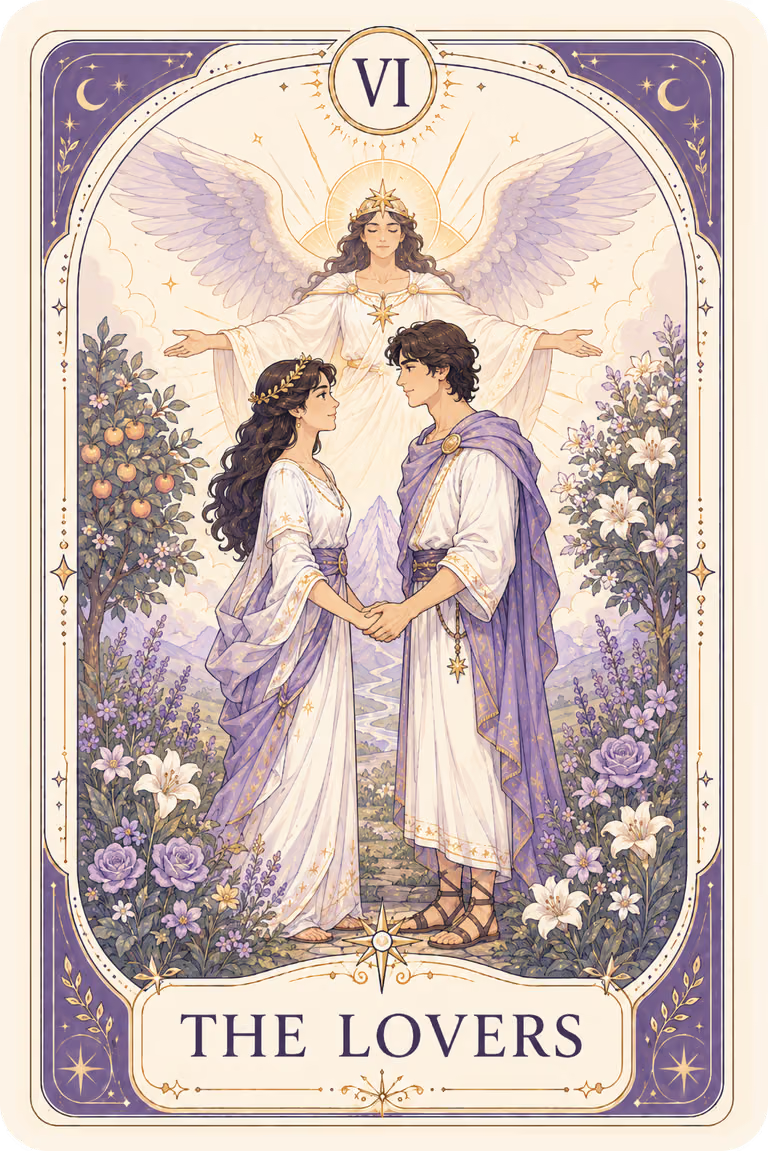
Explore The Hierophant →The Lovers
union · choice · values
Less about romance than about choosing. The Lovers is the point where two things cannot both be kept, and the choice will say something true about your values.
Explore The Lovers →The Chariot
willpower · determination · control
Momentum held together by will. Two forces pull in different directions and you move anyway — which works, so long as you know what is actually driving.
Explore The Chariot →Strength
courage · compassion · inner strength
Power that does not need to dominate. Strength is patience with something wild — a fear, an appetite, another person — met with steadiness rather than force.
Explore Strength →The Hermit
solitude · introspection · inner guidance
Deliberate withdrawal in order to hear yourself. Not loneliness: a chosen quiet, and the light you carry back from it.
Explore The Hermit →Wheel of Fortune
cycles · fate · turning point
The turn you did not arrange. Circumstances move, luck arrives or leaves, and the useful question becomes what you do with a situation you did not choose.
Explore Wheel of Fortune →Justice
fairness · truth · cause and effect
Consequence and clear sight. Justice weighs what actually happened rather than what was intended — and asks you to do the same, including with yourself.
Explore Justice →The Hanged Man
surrender · new perspective · pause
Suspension that turns out to be useful. Nothing moves, and the view changes anyway. Often the card of a pause you resent and later value.
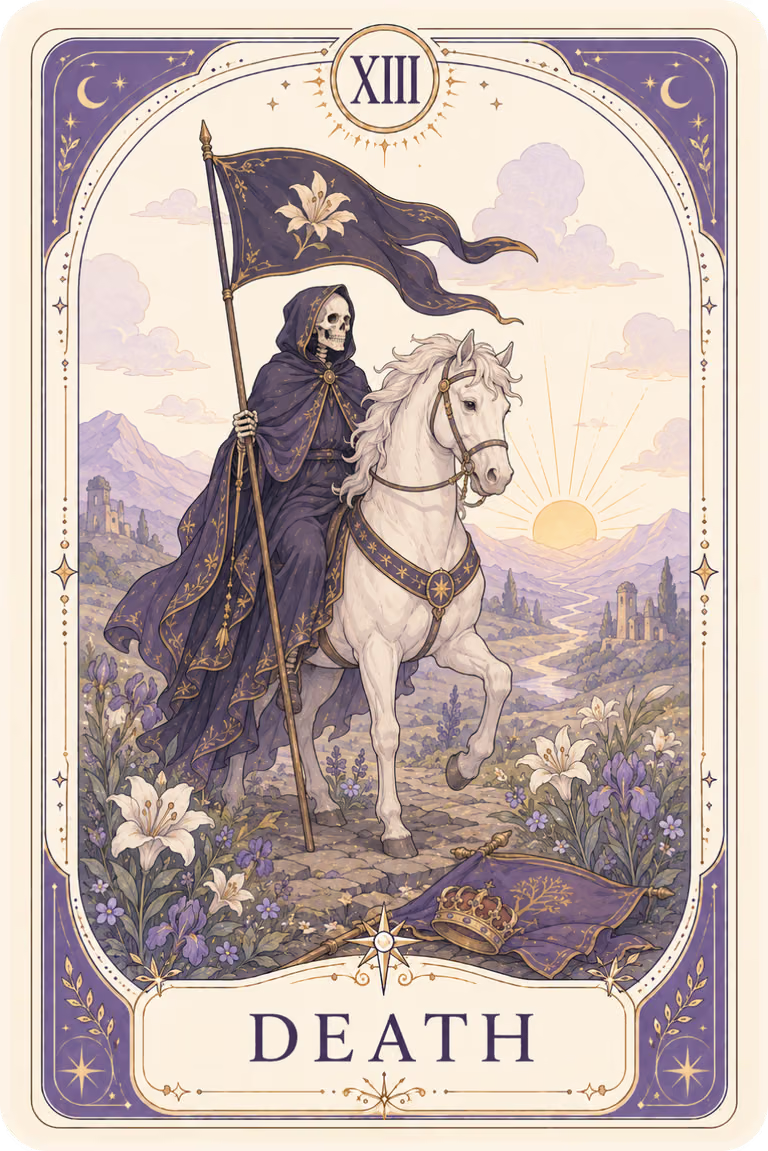
Explore The Hanged Man →Death
transformation · ending · rebirth
An ending that clears ground. Almost never literal — this is the card of a chapter genuinely finishing, and of how much easier that is once you stop negotiating with it.
Explore Death →Temperance
balance · moderation · patience
Blending, proportion, the middle path found by adjustment rather than compromise. It is slow work and it is the card of getting the mixture right.
Explore Temperance →The Devil
attachment · shadow · temptation
Attachment that has quietly become a cage — a habit, a story, a relationship you could leave and do not. The chains in the image are famously loose.
Explore The Devil →The Tower
upheaval · sudden change · revelation
Sudden collapse of something that was already unsound. Unwelcome and clarifying in equal measure; what falls is usually what could not have held.
Explore The Tower →The Star
hope · inspiration · serenity
Quiet hope after difficulty. Not triumph — the return of the sense that things can be repaired, and the calm that lets you begin.
Explore The Star →The Moon
illusion · intuition · subconscious
Uncertainty, projection, and the difficulty of telling fear from intuition. A card for going slowly and distrusting the story you are telling in the dark.
Explore The Moon →The Sun
joy · vitality · success
Clarity and simple gladness. Things are what they appear to be, which after the Moon is its own kind of relief.
Explore The Sun →Judgement
awakening · reckoning · rebirth
Reckoning and the call to answer for yourself. Looking honestly at what has happened, and deciding who you are going to be about it.
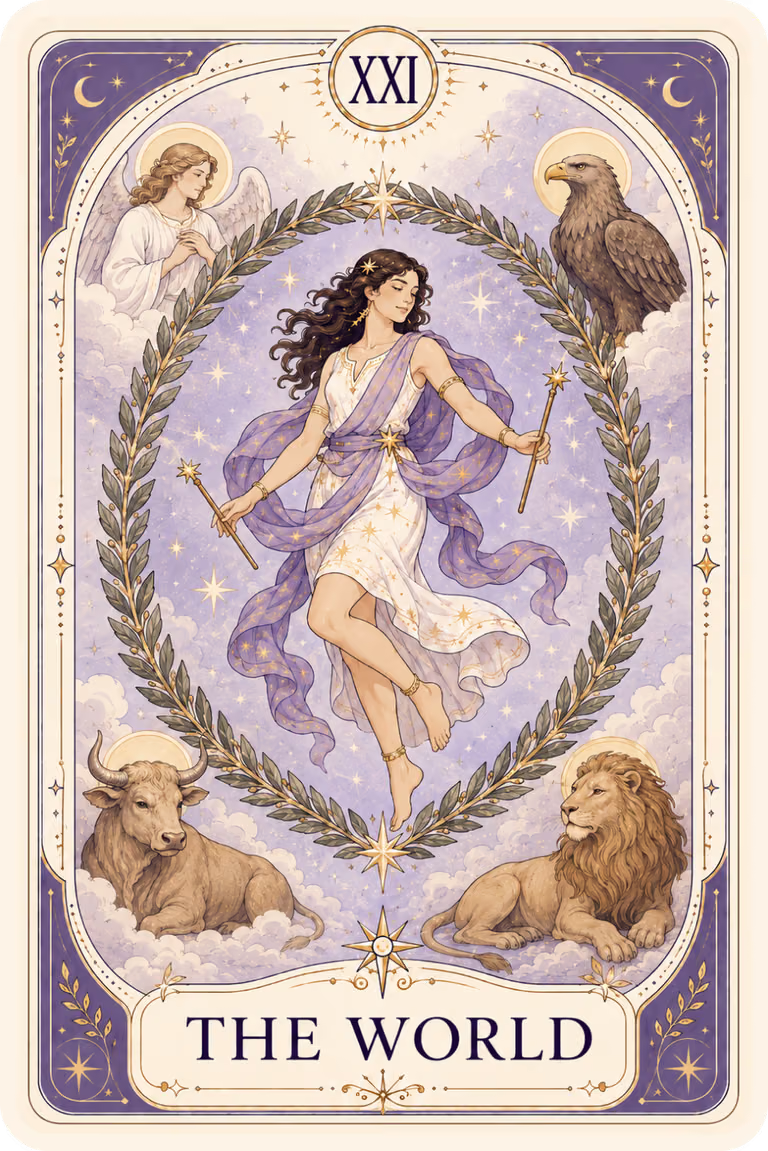
Explore Judgement →The World
completion · wholeness · integration
Completion, and the pause before the next beginning. Not perfection — a circle genuinely closed, with everything it taught still on you.
Explore The World →
When several Major Arcana appear together#
In a three-card spread, one Major among two Minors usually marks where the weight sits. Two or three Majors together suggests the question is bigger than the situation you asked about — the reading has quietly widened from “this week” to “this period of my life”.
That is not cause for alarm, and it is not evidence that something dramatic is coming. It more often means the question you asked was standing in for a larger one. When it happens, the most useful move is to stop interpreting and ask yourself what the real question is — then draw again another day, once you can name it.
It is also worth reading Majors in sequence. If the Tower sits before the Star, the story runs from collapse toward repair; reversed in order, it reads as calm before disruption. The order in a spread carries as much meaning as the cards themselves.
Key takeaways
- The Major Arcana are the 22 unsuited cards, numbered 0–21; they describe the frame around a situation rather than its daily detail.
- “Majors matter more” is a convention, not a rule — a card matters because of what it shows you about your question.
- The Fool’s Journey is a modern interpretive frame, useful for learning but not the cards’ original design.
- Death, the Tower and the Devil name ordinary human experiences; they are not omens.
- Several Majors at once usually means the question is larger than the one you asked.
Frequently asked questions
Do I need to memorise all 22 Major Arcana?
No, and trying to tends to slow people down. Look up each card as it appears in a real reading; meeting the Tower once when it actually lands teaches more than a week of flashcards.
Is drawing a Major Arcana card a big deal?
It is a signal to look at the wider theme rather than the immediate detail. It is not evidence that something significant is about to happen — that reading imports a claim about the future the cards cannot support.
Why are there 22 of them?
The count comes from tarot’s origins as a card game, where the 21 numbered trumps plus the unnumbered Fool formed a separate ranking above the four suits. Later traditions attached symbolic systems to that structure, but the number itself is inherited from play.
What is the difference between Major and Minor Arcana?
The 22 Majors are unsuited, named cards dealing with broad themes. The 56 Minors are divided into four suits — Wands, Cups, Swords and Pentacles — and describe the everyday textures of a situation.
Continue your practice
The Majors make most sense one at a time, in a real question.